Abstraction layer header for retro systems. More...
Collaboration diagram for RetroFlat API:
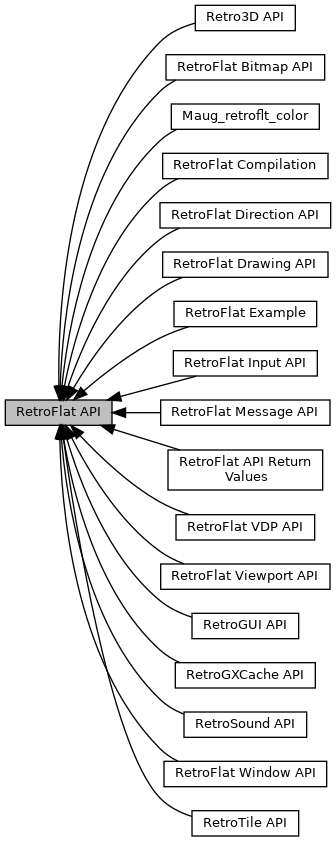
Modules | |
| RetroFlat Example | |
| An extremely simple single-file annotated example program written with the RetroFlat API. | |
| RetroFlat Compilation | |
| Makefile examples and compiler considerations for using RetroFlat. | |
| Maug_retroflt_color | |
| RetroFlat API Return Values | |
| Standardized return values from RetroFlat API functions. | |
| RetroFlat Drawing API | |
| Functions for drawing primitives on-screen. | |
| RetroFlat Message API | |
| These flags can be passed to retroflat_message() to indicate the type of message being conveyed. | |
| RetroFlat VDP API | |
| Video Display Processor tools for modifying display output. | |
| RetroFlat Platform Function API | |
| Callbacks for handling platform events like focus/size changes. | |
| RetroFlat Bitmap API | |
| Tools for loading bitmaps from disk and drawing them on-screen. | |
| RetroFlat Input API | |
| Functions and constants for polling and interpreting user input. | |
| RetroFlat Direction API | |
| Macros and constants for definition cardinal directions in screen and world space. | |
| Retro3D API | |
| RetroGUI API | |
| Tools for drawing interactive GUI elements in a RetroFlat program. | |
| RetroFlat Window API | |
| Builds on RetroGUI API to allow for multiple windows. | |
| RetroFlat Common Dialogs | |
| Provides some common dialog types using RetroGUI API and RetroFlat Window API. | |
| RetroGXCache API | |
| RetroTile API | |
| Functions and structures for working with tilemaps/grids. | |
Files | |
| file | retroflt.h |
| Abstraction layer header for retro systems. | |
Data Structures | |
| struct | RETROFLAT_3DTEX |
| struct | RETROFLAT_ARGS |
| Struct containing configuration values for a RetroFlat program. More... | |
| struct | RETROFLAT_STATE |
| Global singleton containing state for the current platform. More... | |
Macros | |
| #define | RETROFLAT_BITMAP_TRACE_LVL 0 |
| #define | RETROINPUT_TRACE_LVL 0 |
| #define | RETROFLAT_DEFAULT_SCREEN_W 320 |
| #define | RETROFLAT_DEFAULT_SCREEN_H 200 |
| #define | RETROFLAT_DEFAULT_SCREEN_SCALE 1 |
| #define | retroflat_on_resize(w, h) |
| #define | retroflat_wait_for_frame() (g_retroflat_state->retroflat_flags |= RETROFLAT_STATE_FLAG_WAIT_FOR_FPS) |
| #define | retroflat_is_waiting_for_frame() |
| #define | retroflat_outside_rect(x, y, rx, ry, rw, rh) |
| #define | PXXY_FMT "%d" |
| #define | PXXY_MAX INT16_MAX |
| #define | RETRO2D_TRACE_LVL 0 |
| #define | RETRO2D_DRAW_TRACE_LVL 0 |
| #define | RETRO2D_LOCK_TRACE_LVL 0 |
| #define | retroflat_system_task() |
| Platform-specific task that should be called on every iteration of the generic loop. This prevents having to define a platform-specific loop just to add a single call. | |
| #define | retroflat_get_assets_path() (g_retroflat_state->assets_path) |
| #define | RETROFLAT_COLOR_TABLE_CONSTS(idx, name_l, name_u, r, g, b, cgac, cgad) extern MAUG_CONST RETROFLAT_COLOR SEG_MCONST RETROFLAT_COLOR_ ## name_u; |
Typedefs | |
| typedef void(* | retroflat_loop_iter) (void *data) |
| Prototype for the main loop function passed to retroflat_loop(). | |
| typedef int16_t | retroflat_pxxy_t |
| Type used for surface pixel coordinates. More... | |
| typedef maug_ms_t | retroflat_ms_t |
| typedef void(* | retroflat_timer_cb_t) (retroflat_ms_t time, void *data) |
Functions | |
| uint32_t | retroflat_get_rand (void) |
| retroflat_ms_t | retroflat_get_ms (void) |
| MERROR_RETVAL | retroflat_loop (retroflat_loop_iter frame_iter, retroflat_loop_iter loop_iter, void *data) |
| This should be called once in the main body of the program in order to enter the main loop. The main loop will continuously call loop_iter with data as an argument until retroflat_quit() is called. | |
| MERROR_RETVAL | retroflat_build_filename_path (const maug_path filename_in, const char *filename_ext, char *buffer_out, size_t buffer_out_sz, uint8_t flags) |
| MERROR_RETVAL | retroflat_init (int argc, char *argv[], struct RETROFLAT_ARGS *args) |
| Initialize RetroFlat and its underlying layers. This should be called once at the beginning of the program and should quit if the return value indicates any failures. More... | |
| void | retroflat_shutdown (int retval) |
| Deinitialize RetroFlat and its underlying layers. This should be called once at the end of the program, after retroflat_loop(). More... | |
| RETROFLAT_IN_KEY | retroflat_repeat_input (RETROFLAT_IN_KEY key_out, struct RETROFLAT_INPUT *input, RETROFLAT_IN_KEY *prev_input, int *prev_delay) |
| void | retroflat_set_title (const char *format,...) |
| char | retroflat_vk_to_ascii (RETROFLAT_IN_KEY k, uint8_t flags) |
Variables | |
| MAUG_CONST char *SEG_MCONST | gc_retroflat_color_names [] |
| struct RETROFLAT_STATE *SEG_MGLOBAL | g_retroflat_state |
Detailed Description
Abstraction layer header for retro systems.
Macro Definition Documentation
◆ retroflat_is_waiting_for_frame
| #define retroflat_is_waiting_for_frame | ( | ) |
Value:
(g_retroflat_state->retroflat_flags & RETROFLAT_STATE_FLAG_WAIT_FOR_FPS))
uint8_t retroflat_flags
maug_retroflt_flags indicating current system status.
Definition: retroflt.h:1140
#define RETROFLAT_STATE_FLAG_WAIT_FOR_FPS
Do not execute any more inter-frame loops until next frame.
Definition: retroflt.h:426
◆ retroflat_on_resize
| #define retroflat_on_resize | ( | w, | |
| h | |||
| ) |
Value:
g_retroflat_state->screen_w = (w); \
g_retroflat_state->screen_h = (h);
size_t screen_w
The screen width as seen by the system, after scaling.
Definition: retroflt.h:1196
◆ retroflat_outside_rect
| #define retroflat_outside_rect | ( | x, | |
| y, | |||
| rx, | |||
| ry, | |||
| rw, | |||
| rh | |||
| ) |
Value:
((unsigned int)(x - rx) >= (unsigned int)rw || \
(unsigned int)(y - ry) >= (unsigned int)rh)
Typedef Documentation
◆ retroflat_pxxy_t
| typedef int16_t retroflat_pxxy_t |
Type used for surface pixel coordinates.
- Todo:
- Make this signed when most of the library uses it. Right now, it causes too many issues with passed references.
Function Documentation
◆ retroflat_init()
| MERROR_RETVAL retroflat_init | ( | int | argc, |
| char * | argv[], | ||
| struct RETROFLAT_ARGS * | args | ||
| ) |
Initialize RetroFlat and its underlying layers. This should be called once at the beginning of the program and should quit if the return value indicates any failures.
- Returns
- RETROFLAT_OK if there were no problems or other RetroFlat API Return Values if there were.
◆ retroflat_shutdown()
| void retroflat_shutdown | ( | int | retval | ) |
Deinitialize RetroFlat and its underlying layers. This should be called once at the end of the program, after retroflat_loop().
- Parameters
-
retval Return value from retroflat_init(), so we know what layers are in what state.